There are times when a person does not need another vacation.
A vacation can be good. A few days away can help. A change of scenery can give the mind a little breathing room.
But sometimes the need is quieter than that.
Sometimes a person does not need more entertainment, more scheduling, more scenery, more plans, or more advice.
Sometimes a person needs a place to sit still long enough to hear what has been running underneath the noise.
That is where The Pencil-Driven Life and West Hollow meet.
The Pencil-Driven Life began with a simple idea: a life can be noticed, questioned, revised, and marked again. Not dramatically. Not all at once. Not as a performance. But honestly, with enough quiet to see what has been inherited, what still fits, what no longer belongs, and what small mark might be made next.
A pencil is a modest tool. That is part of its strength. It does not ask for certainty. It allows revision. It reminds us that a mark can be made without pretending it has to be final.
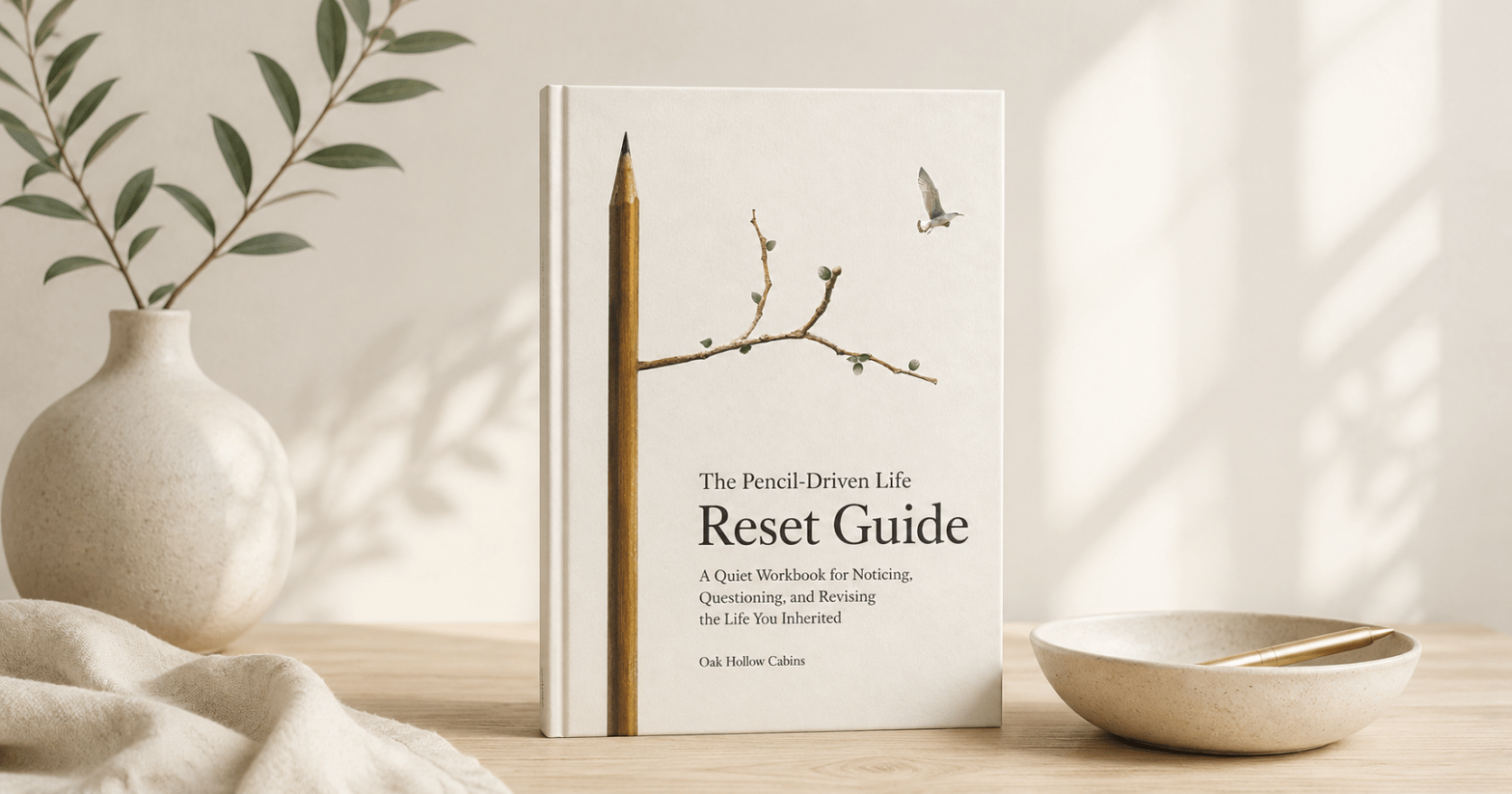
That is the spirit behind The Pencil-Driven Life Reset Guide, a quiet workbook for noticing, questioning, and revising the life you inherited.
And that is also the spirit behind West Hollow.
West Hollow is not a resort cabin. It is not a party cabin, a couple’s getaway, or a vacation rental built around entertainment. It is a simple one-person reset cabin at Oak Hollow Cabins near Boaz, Alabama, created for quiet, reading, writing, rest, walking, sitting by the fire, and being unavailable on purpose for a little while.
In that sense, West Hollow is the cabin expression of The Pencil-Driven Life.
The cabin gives the practice a place.
The Guide gives the stay a shape.
The quiet gives the person room.
Not everyone needs this. But some people do.
Some people are tired of being useful all the time. Some are carrying roles that no longer fit. Some are in transition. Some are burned out by ordinary noise. Some are questioning inherited expectations around work, family, faith, responsibility, success, obedience, approval, or keeping going no matter what.
Some people do not yet know what needs to change. They only know they need enough quiet to stop performing for a few days.
The Pencil-Driven Life does not promise to fix that.
West Hollow does not promise transformation.
The Reset Guide does not pretend to be therapy, religion, or a productivity program.
The invitation is smaller and, I think, more honest:
Come away for a little while.
Bring a pencil.
Listen to your life.
Make one honest mark.
Carry that mark home.
That may not sound like much. But for some people, one honest mark is not small.
One honest mark may be the first time they have admitted they are tired.
One honest mark may be the first question they have allowed themselves to ask.
One honest mark may be the sentence, “This is not mine to carry.”
Or, “I can question what shaped me without despising where I came from.”
Or, “Rest is allowed before collapse.”
Or simply, “I do not know yet.”
That counts.
The life we inherit is rarely handed to us as a single document. It comes one sentence at a time. Be good. Be useful. Do not disappoint them. Keep going. Stay quiet. Believe what you were taught. Make everyone proud. Work harder. Need less. Hold it together.
Some of those sentences may still contain truth. Some may have helped us survive. Some may deserve gratitude.
But some may need to be revised.
That is the work of a pencil-driven life: not erasing the past, not despising where we came from, not pretending we can begin from nowhere, but looking honestly at the marks already on the page.
What did I inherit?
What did it give me?
What did it cost?
What still fits?
What no longer belongs?
What is the next honest line?
A simple cabin can help with that because it removes some of the usual coverings. There is less to manage. Less to consume. Less to perform. The day becomes plainer. A chair, a bed, a notebook, a walk, a fire, a cup of coffee, a quiet page.
That simplicity is not accidental. It is part of the invitation.
West Hollow is simple on purpose.
The Reset Guide is simple on purpose.
The practice is simple on purpose.
Not easy, necessarily. But simple.
The world many of us return to will still be noisy. The old requests may still be waiting. The old roles may still recognize us. The old pace may try to reclaim us before we are ready.
A reset does not remove us from ordinary life forever.
It helps us return with a little more honesty.
That is why the Guide does not end with escape. It ends with reentry. The point is not to preserve cabin quiet perfectly. The point is to carry one honest mark back into the life that is actually ours.
For some people, the printed Guide may be enough. It can be used at home, on a porch, at a desk, in a park, during a weekend away, or anywhere a person can find a little quiet and a pencil.
For others, the cabin may matter.
There is a difference between reading about quiet and physically stepping into it.
There is a difference between wanting to think and giving yourself a real place and a real date to do it.
West Hollow exists for that person.
Not the person looking for luxury.
Not the person looking for entertainment.
Not the person looking for a crowded weekend.
The person who needs less noise and more honesty.
The person who wants to read, write, rest, walk, sit, think, and be unavailable on purpose.
The person who may not need a new life as much as a quieter way to revise the one already in front of them.
That is the connection I am beginning to see more clearly.
The Pencil-Driven Life is the practice.
The Reset Guide is the companion.
West Hollow is the place.
And the next honest line is enough.
Continue with The Pencil’s Edge
A Pencil Practice
Sometime this week, take a pencil and write:
The noise I most need to step away from is…
Let the answer be honest.
It may be outer noise: phones, messages, work, errands, screens, obligations, other people’s needs, or the constant habit of being available.
It may be inner noise: fear, pressure, guilt, old expectations, inherited roles, the need to be useful, the need to keep going, or the belief that rest must be earned.
Then write:
If I had a quieter place for one day, I might finally notice…
Do not force the answer. Do not make it impressive. Let the sentence open slowly.
Maybe you would notice that you are tired. Maybe you would notice a question you have been avoiding. Maybe you would notice that an old role no longer fits. Maybe you would notice that you do not know what comes next. Maybe you would simply notice how long it has been since you sat still without needing to respond.
Then ask:
What is one honest mark I could carry back into ordinary life?
Keep it small.
A sentence.
A boundary.
A question.
A permission.
A decision to rest before collapse.
A willingness to say, “I do not know yet.”
That may be enough for today.
Listen
Short audio reflections from The Pencil’s Edge are available on the Audio Reflections page.
New audio reflections are added after each essay is published.
Listen to the Audio Reflections:
Subscribe
Receive new essays and short audio reflections from The Pencil-Driven Life when they are published.
And the next honest line is enough.

 The Pencil-Driven Life