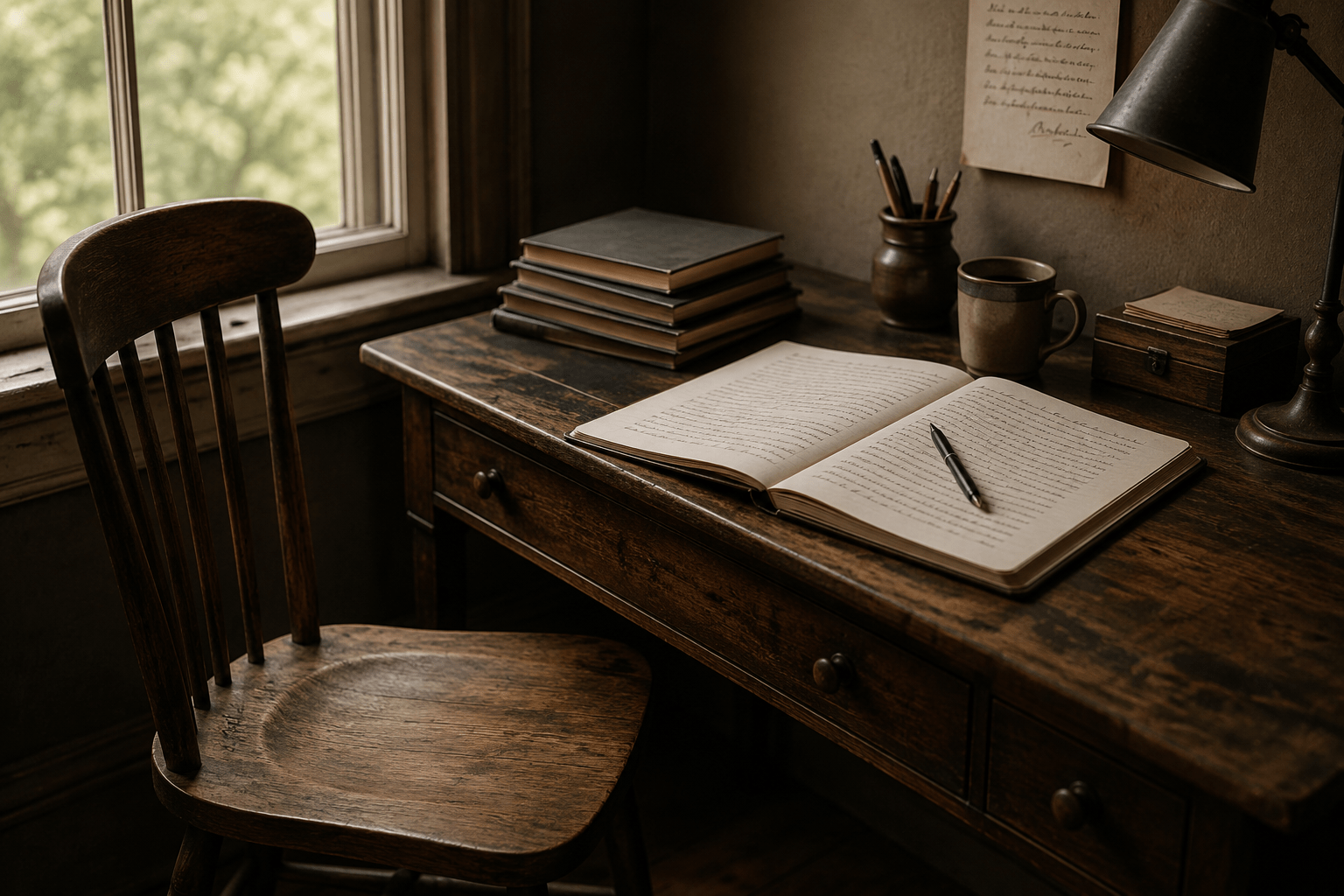
I’ve spent a good bit of time lately going back through writing I did months ago, particularly early work on the Billy and Molly series and I Dare You, Teacher. It’s an interesting experience, reading something you remember writing but no longer seeing it quite the way you did when you wrote it.
Some of what I’ve found isn’t very good. That’s actually the easy part. If a scene doesn’t work or a paragraph says in three hundred words what I could now say in fifty, there’s not much reason to agonize over it.
The harder part is finding something that is pretty good and realizing I don’t want it anymore.
I’ve run into that several times lately. I’ll read a passage and remember working on it, sometimes working quite hard on it. I may still like the language. I may even think it accomplishes what I intended for it to accomplish.
The problem is that what I intended then isn’t necessarily what I’m trying to do now.
I’ve been thinking about that, because I don’t believe the difference is simply that I’ve become a better writer over the past few months. I hope I’ve improved, but something else has changed too. I’ve changed my mind.
I saw that rather dramatically while revising I Dare You, Teacher. When I first began working on that manuscript, I was much more inclined to approach certain questions the way I approached questions during my years as a courtroom lawyer. Here’s the issue. Here’s the evidence. Here’s why this position holds up and that one doesn’t.
I can still do that. In fact, I suspect it will always come rather naturally to me.
I’m just not as interested in doing it anymore.
I’ve encountered much the same thing with Billy and Molly. I don’t want characters standing around waiting for me to hand them positions so they can make my case. I want to know who they are, why they believe what they believe, what they’re afraid of, what they want, and sometimes what they themselves don’t quite understand yet.
That means some writing that once seemed perfectly suited to the project no longer fits the project I’ve come to understand.
Writers sometimes talk about “killing your darlings,” but I’ve never particularly cared for that expression. Maybe it’s the drama of it. Most of what I’ve been doing lately doesn’t feel like killing anything.
It feels more like admitting something.
I needed this when I wrote it. I may even have needed to write it before I could get where I am now.
But I don’t need to keep it.
And that’s where this started following me away from the writing desk.
I wonder how often we confuse the value of having done something with the need to keep doing it.
Those aren’t the same thing, are they?
I’ve spent ten hours on a chapter. I’ve spent three years on a project. I’ve spent twenty years building a business. I’ve spent most of my life believing something. Whatever the investment happens to be—time, money, work, reputation, hope—there’s a powerful temptation to let what I’ve already put into something determine what I should do with it now.
I understand that temptation. I feel it when I’m staring at a paragraph I like and trying to find some excuse for leaving it in the manuscript.
Maybe I can move it.
Maybe it belongs in another chapter.
Maybe if I change the paragraph before it, I can make the thing fit.
Before long, I’m revising everything around the sentence instead of asking the simpler question: Does this sentence still belong?
I suspect we can do something similar with larger things.
Of course, I don’t mean that every difficult project should be abandoned or that changing our minds is always evidence of growth. Sometimes the thing we most need is persistence. Some worthwhile work takes years before we can see what it’s becoming, and I’ve written recently about the danger of using quick recognition as our measure of value.
So I’m not trying to make a case for quitting.
I’m interested in a different question, one I’ve found myself asking while looking at these old manuscripts:
If I were encountering this honestly today, would I still choose it?
I don’t find that question particularly comfortable.
It doesn’t give the ten hours I spent writing the chapter a vote. It doesn’t care that I once defended the idea rather vigorously. It doesn’t even require me to decide that my earlier choice was wrong.
That last part may be what interests me most.
When I read something I wrote months ago and can now see its weaknesses, my first reaction can be, Why didn’t I see this then? But maybe that’s not a particularly useful question. I was writing from where I was then, with what I understood then.
The old draft may have been necessary.
Maybe I had to make the argument before I could recognize how much I was arguing.
Maybe I had to write a character as a position before I could learn to become curious about the person.
Maybe I had to write the book I thought I wanted before I could discover the book I actually wanted to write.
Seen that way, deleting the old work doesn’t make it wasted work. It may have done exactly what it needed to do.
I think there’s something in that for life beyond a manuscript.
Changing my mind today doesn’t necessarily mean I was foolish yesterday. Ending something doesn’t necessarily mean beginning it was a mistake. Letting go of an old plan doesn’t erase whatever following that plan taught me.
Sometimes, I suppose, a thing can be worth doing and still not be worth continuing.
That’s a distinction I haven’t always made very well.
A manuscript is rather unforgiving about it. The page doesn’t care how much time I spent on the paragraph. It doesn’t care how pleased I was when I first wrote it. The only useful question is whether the paragraph belongs in the book that’s taking shape now.
Life is obviously more complicated than a manuscript. People are involved. Commitments matter. Consequences matter. We don’t get to erase a marriage, a business, a friendship, or a responsibility because we’ve suddenly imagined a cleaner second draft.
Still, I wonder whether revision offers something worth carrying with us.
Maybe we can respect an earlier choice without being permanently governed by it.
Maybe we can be grateful for what an old belief, plan, project, or season gave us without requiring it to remain forever.
Maybe occasionally we can look at what is actually on the page now instead of spending all our energy defending what we wrote three chapters ago.
I suppose that’s one reason the pencil continues to appeal to me.
An eraser doesn’t tell me the first mark was stupid. It doesn’t pretend the mark was never there. If I paid attention, that first mark probably helped me see where the next one needed to go.
The pencil simply allows me to look again.
That’s what I’ve been doing with these manuscripts lately.
I’m beginning to suspect it’s something I’ll be doing with myself for the rest of my life.
Writing continues to teach me that.
Continue with The Pencil’s Edge
A Pencil Practice
Think of something you’ve invested a great deal in. It might be a project, a plan, an idea, a habit, or something else you’ve carried for a long time.
Don’t begin by asking whether you were wrong to choose it.
Instead, write this question:
If I were encountering this honestly today, would I still choose it?
Then follow the pencil wherever it goes. You don’t have to make a decision or defend what you write.
Read it once.
When you have finished, the practice is complete.
Listen
Prefer listening?
Listen to today’s Reflection on Spotify.
Subscribe
New Reflections are published every Monday and Thursday morning at The Pencil-Driven Life.

 The Pencil-Driven Life