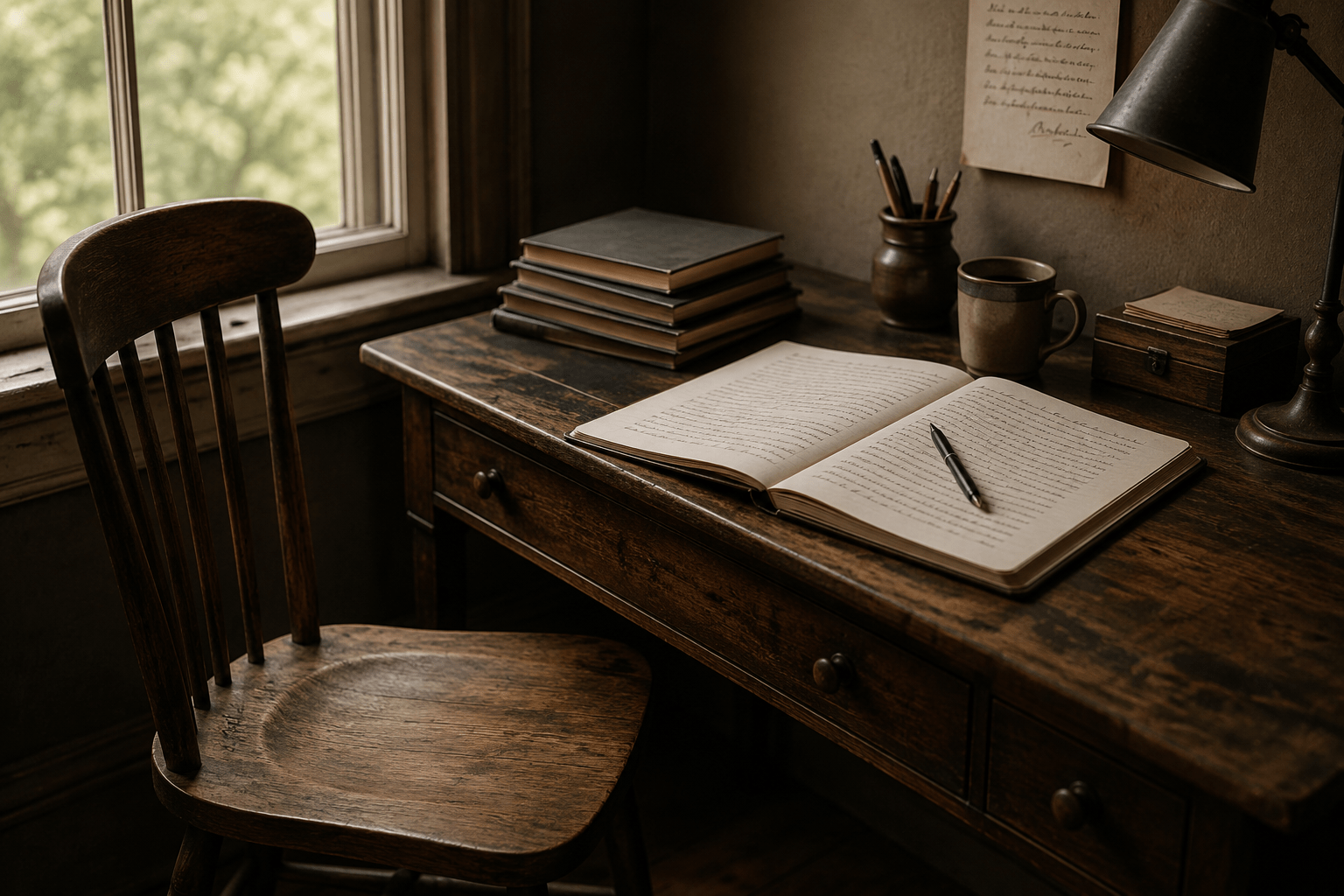
I have an odd habit at night.
I reread my own novels.
I’ve been doing it for years, and I suppose there are several reasons for it. I enjoy returning to the characters. I notice things I would write differently now. Sometimes I remember exactly where I was when I wrote a particular scene; other times I can read several pages and have almost no memory of having written them.
Lately, though, I’ve started doing something different with those books.
I’m taking inventory.
Not counting them. I already know how many novels I’ve published.
I’m trying to figure out what is actually sitting on that shelf.
That may sound like a strange thing for the person who wrote the books to say, but I’m beginning to think it isn’t strange at all. I wrote these novels across a number of years, usually with my attention fixed on the book directly in front of me. Finish this scene. Solve this character problem. Get through the next chapter. Finish the manuscript. Publish it.
Then move on to the next one.
I don’t remember ever stepping far enough away from the individual books to ask what they looked like together.
Now I’m doing that.
I’ve started going back through them one by one, beginning with God and Girl, then The Boaz Scorekeeper, The Boaz Secrets, The Boaz Schoolteacher, and eventually the rest.
At first, the reason seemed fairly practical.
I’ve done almost nothing to market these novels.
That’s a little embarrassing to admit because I spent years writing them. I published them, put them on Amazon, mentioned them here and there, and then largely left them alone.
And yet I still believe there are people who would enjoy these stories if they knew the books existed.
So before I begin trying to tell readers why they might want to read them, I thought I ought to take a closer look myself.
What exactly did I write?
Who might these books be for?
What themes keep appearing?
What kinds of characters seem to interest me?
Which books still feel especially alive to me?
And, maybe just as important, what do these novels reveal about the writer I was becoming while I wrote them?
That last question has surprised me.
Looking Back Without Putting Myself on Trial
There is a temptation when returning to old work to become a critic almost immediately.
I can find things I would change.
Plenty of them.
A sentence runs too long. A scene could probably begin two pages later. I explain something the reader would have understood without my help. A character says something I now wish I’d allowed him to reveal in another way.
That’s inevitable, I suppose.
I’ve kept writing.
If fourteen novels haven’t changed the way I write, something has gone badly wrong.
But I’m trying not to turn this inventory into a trial of the younger writer.
I’m more interested in understanding him.
Why did he keep returning to certain questions?
Why were secrets so important?
Why belief?
Why guilt?
Why family?
Why the small town?
Why characters who have been carrying something for years and finally reach the point where they can’t carry it quietly anymore?
I don’t remember sitting down before each novel and deciding, This is what Richard Fricks writes about.
I just wrote the story that interested me.
Now, looking across the shelf, I’m beginning to see patterns I couldn’t see while I was inside the individual books.
That fascinates me.
It also makes me wonder how much of our lives becomes visible only in retrospect.
The Work May Know Something Before We Do
A novelist can spend months believing a book is about one thing and discover much later that something else was moving underneath it.
I’ve experienced that more than once.
The plot may involve a crime, a secret, a church, a school, a family, or some other problem that needs to be resolved. But years later, when I return to the book, I notice a question that seems to have been there from the beginning.
What do people do with a truth they are afraid to tell?
What happens when belonging requires silence?
How long can someone live inside a story about himself that no longer feels true?
I know those questions much better now.
I’m not sure I knew I was asking them then.
Maybe the work knew before I did.
That’s one of the things writing continues to teach me. We don’t always understand what we’re making while we’re making it.
Sometimes we need distance.
Sometimes we need years.
Sometimes we have to put several books beside one another before the pattern becomes visible.
Why Didn’t I Tell Anyone?
There’s another question I can’t avoid.
If I believe these novels may have something worthwhile in them, why did I do so little to help readers find them?
I don’t have a very impressive answer.
Part of it is probably temperament. I would rather write the next book than promote the last one.
Part of it may be discomfort with self-promotion. Saying, I wrote this, is easy enough. Saying, I think you ought to spend your money and several hours of your life reading it, feels different.
And part of it, I suspect, is that I never did the work I’m doing now.
I never really examined the shelf.
I never asked what connected the books, which ones might appeal to which readers, or how I would describe the experience of reading them without reducing them to plot summaries.
Maybe I was asking the marketing question too early.
Before I ask, How do I sell these books? I probably need to ask:
What have I actually made?
I like that question better.
It feels less promotional and more honest.
Returning to Old Work
This isn’t only about books.
Most of us have a shelf somewhere, even if there are no novels on it.
It may be a business we’ve spent years building.
A stack of photographs.
A career.
A garden.
A body of woodworking.
A marriage.
Children we’ve raised.
Old journals.
A church we once gave much of ourselves to.
A piece of land we’ve slowly changed.
We tend to experience these things one day at a time.
Do today’s work.
Solve today’s problem.
Get through this season.
Then another year passes.
Eventually, if we’re fortunate enough to stop and look, we may discover that the individual days have become something.
Maybe something different from what we expected.
Maybe something we don’t yet know how to describe.
I think that’s what I’m doing with my fiction right now.
I’m standing a little farther back and looking.
Not asking whether every book is perfect.
They’re not.
Not trying to persuade myself that everything I’ve written deserves a new audience.
I don’t know that yet either.
I’m simply trying to see what’s there.
And I have a feeling that seeing clearly needs to come before marketing.
Maybe it needs to come before a lot of things.
The Shelf Looks Different From Here
It’s interesting to reread a book I wrote years ago and realize that both of us have changed.
The book hasn’t changed, of course.
I have.
I bring different questions to it now.
I notice different things.
I am more sympathetic to some characters and less convinced by others. I can see places where the writing was trying too hard, but I can also see moments when I apparently trusted the story more than I remember trusting myself.
Every now and then, I come across a scene and think, That’s pretty good.
I enjoy those moments.
Not because they prove anything.
Mostly because I had forgotten.
And maybe that’s part of what this inventory is becoming.
Not an exercise in nostalgia.
Not an exercise in judgment.
An exercise in attention.
Before I decide what to do with these books, I want to know them again.
I want to understand what connects them, where they differ, what they reveal about the writer who wrote them, and whether there are readers out there who might recognize something of themselves in these stories.
Then we’ll see what comes next.
For now, I’m still looking at the shelf.
And writing continues to teach me that sometimes we don’t fully see what we’ve made until we’re willing to return and look again.
Continue with The Pencil’s Edge
A Pencil Practice
Think of something you’ve made, built, written, raised, tended, or carried for a long time.
Don’t evaluate it yet.
Instead, write this question:
What is actually here that I may not have noticed while I was making it?
Spend a few minutes looking back without trying to praise yourself or criticize yourself.
Just notice.
Write whatever surprises you.
Read it once.
When you have finished, the practice is complete.
Listen
Prefer listening?
Listen to today’s Reflection on Spotify.
Subscribe
New Reflections are published at The Pencil-Driven Life.

 The Pencil-Driven Life