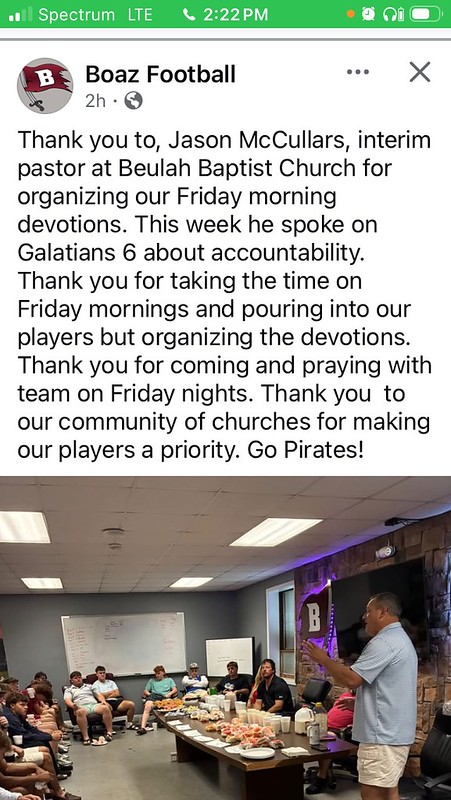
On September 22, I published an essay under this same title. I am returning to the subject because that first essay did not fully examine the responsibility of the coaches themselves. The issue is not only that a pastor brought Christian teaching into a football setting. The coaches are educators exercising public-school authority, and by creating, approving, and promoting these devotions, they lend that authority to the religious claims being presented.
Today’s essay also addresses a likely response: that Christianity, God, Jesus, and the Bible are not merely matters of belief but well-established facts. It distinguishes historical facts from theological claims and asks what honest inquiry requires when students’ opportunities and sense of belonging are involved.
This is therefore not simply a repost. It is a fuller and more direct examination of how coaching authority, protected certainty, and the pressures of team belonging can turn a supposedly voluntary devotion into institutional Christian formation.
A recent public post from Boaz Football thanked Jason McCullars, interim pastor of Beulah Baptist Church, for organizing the team’s Friday morning devotions. According to the post, he spoke to the players from Galatians 6 about accountability, prays with the team on Friday nights, and is supported by a “community of churches” that has made the players a priority.
I disagree with this practice.
A public-school football program should not be used to present Christianity, the Bible, or God as settled truth to the young people under its authority.
The religious claims being presented—about God, Jesus, the Bible, and Galatians—are theological conclusions, not neutral moral knowledge that can be handed to every football player as though no serious question exists.
The Boaz Football post acknowledges none of that. It does not describe Christian players independently organizing a voluntary gathering for students who share their beliefs. It calls these gatherings “our Friday morning devotions.” It thanks a pastor for organizing them and churches for making “our players” a priority.
The language tells us who is acting upon whom. The pastor teaches. The churches reach out. The football program approves and promotes. The assembled players receive.
That is not religious neutrality. It is institutional endorsement of Christianity.
The Coaches Are Teaching Too
The visiting pastor is not the only teacher in this room.
The football coaches are teachers as well. Even if a particular coach does not teach an academic class, he occupies an educational role within a public school. He instructs players, evaluates their performance, corrects their behavior, imposes discipline, rewards effort, determines participation, and models what the institution considers admirable.
He also controls something especially important to adolescents: their place on the team.
The coaches therefore cannot avoid responsibility by saying that the pastor delivered the religious message. The pastor may be speaking, but the football program created the setting, assembled the players, approved the speaker, incorporated the devotion into team life, and publicly celebrated the relationship with local churches.
The pastor brings the Bible. The coaches lend him the authority of the team.
That distinction is central to I Dare You, Teacher: Question What You Teach (my forthcoming book about teaching, authority, and honest inquiry). A teacher possesses institutional authority because the school has placed that person in a position to instruct, evaluate, manage, correct, and exercise professional judgment. But institutional authority is not the same as intellectual authority.
A coach may possess legitimate authority to conduct practice, choose a lineup, correct poor technique, enforce team rules, and evaluate a player’s performance. None of that gives him intellectual authority to treat Christianity as true, the Bible as divinely inspired, or Paul’s claimed revelation as knowledge.
The authority to coach football does not become authority to settle religious questions for students.
Certainty Is Not the Same as Knowledge
The coaches might respond that Christianity is not merely their belief. They may say that God’s existence, the divinity of Jesus, the resurrection, and the authority of the Bible are well-established facts.
That response would describe the strength of their conviction. It would not establish the truth of the claims.
Christianity’s existence is a fact. That millions of people believe in God and regard Jesus as divine is a fact about what those people believe. The probable existence of a first-century Jewish teacher named Jesus is a historical conclusion supported by evidence.
But those facts do not establish that a god exists, that Jesus was that god incarnate, that Jesus rose from the dead, that Paul received a revelation from him, or that the Bible was inspired by a supernatural being.
Those are theological claims. They may be believed deeply. They may be repeated by families, churches, coaches, and entire communities. They may have centuries of tradition behind them. None of that converts them into established facts.
A claim does not become knowledge because most people in the room agree with it. Local consensus is not evidence. Tradition is not verification. Sincerity is not proof. Quoting the Bible to establish the divine authority of the Bible is circular: the book is being used to authenticate the supernatural status claimed for the book.
A well-established conclusion remains connected to the evidence supporting it. The evidence can be identified, examined, challenged, and weighed by people who do not already accept the conclusion. A person should also be able to say what evidence might cause the conclusion to be revised.
That is the test offered by I Dare You, Teacher. The alternative to protected certainty is not permanent uncertainty or timid speech. It is justified confidence that remains answerable to relevant evidence.
The coach remains free to hold his faith, attend church, pray, read the Bible, and teach Christianity in an appropriate religious setting. But his private certainty cannot become the team’s required starting point.
The professional question is not whether the coaches are sincere, whether they consider Christianity beneficial, or whether most players already identify as Christian. The question is:
What are the coaches doing with the authority of their role?
They are using it to create and approve a setting in which one religion receives institutional access to the team. Christianity is presented as the normal moral framework. A pastor is authorized to teach from Christian scripture. Prayer becomes part of Friday-night football. Local churches are publicly praised for making the players a priority.
Those decisions teach something before the pastor says a word. They teach which beliefs receive institutional approval, what kind of faith is treated as normal, and what sort of person the program associates with character, accountability, and belonging. They also teach the player who does not share those beliefs that he occupies the unusual position—the position that may require an explanation.
This is how majority culture becomes difficult for insiders to see. When nearly everyone appears to agree, an assumption stops feeling like an assumption. It begins to feel like the room itself.
Silence then becomes easy to misread. A player who remains seated and says nothing may appear to agree. His silence may mean only that disagreement feels expensive.
A Captive Team Audience
These young men are not pictured inside a church they independently decided to visit. They are assembled as members of a football team—a team structured around coaching authority, discipline, loyalty, playing time, and the powerful human need to belong.
That makes them a captive audience in every meaningful sense.
Perhaps no coach explicitly ordered them to attend. The post does not tell us. But coercion does not require a spoken threat. A player already knows how much influence his coaches exercise over his opportunities and his place within the team. He also knows that teammates notice who belongs and who appears different.
The important test is not whether the coaches say that attendance is optional. A choice can be formally free while the environment makes one answer much easier than another.
The more demanding question from I Dare You, Teacher is this:
Could a player respond differently and still remain a full member of the team?
Could he decline the devotion without becoming noticeable? Could he question the pastor without being regarded as disrespectful? Could he refuse prayer without appearing disloyal? Could he keep his beliefs private without having that privacy interpreted as resistance?
If those freedoms are not actively and unmistakably protected, calling the gathering voluntary does not make it free.
Students should be able to question without becoming the question, disagree without becoming an exile, and remain private without having privacy interpreted as defiance.
A coach should not require borrowed agreement as the price of belonging.
Coach Hicks Had It Right
I graduated from Boaz High School in May 1972, and I played football under Coach Hicks. I do not remember him conducting team devotionals, arranging for pastors to instruct us, or mentioning God to us at all.
Looking back, I believe Coach Hicks had it right.
He was not merely teaching us how to block, tackle, practice, and prepare for Friday night. Like every good coach, he was teaching through expectations, discipline, correction, example, and the culture he created around the team.
He taught responsibility, perseverance, preparation, loyalty, and teamwork without presenting Christianity as the source of those qualities. He did not need a pastor or a Bible lesson to build character. He left religion where it belonged—with individual players and their families.
His approach was not hostile to Christianity. Christian players remained free to attend church, pray, read the Bible, and believe in God. Players who believed differently—or who were uncertain—were equally free. Coach Hicks did not use his position to place any of us inside a religious exercise.
He made belonging larger than religious agreement.
That is what freedom of conscience looks like.
What Honest Inquiry Would Require
The present practice protects the conclusion before the players enter the room. God is assumed, the Bible is treated as authoritative, and the players are invited to consider how Christian teaching applies to them—not whether its foundational claims are true.
That is the distinction at the heart of I Dare You, Teacher: protected certainty versus honest inquiry.
Protected certainty occurs when a conclusion receives authority it has not earned and becomes difficult to examine because identity, belonging, reputation, community, or moral self-image depends upon it.
Honest inquiry asks harder questions:
What do we actually know?
What supports this claim?
What kind of claim is it?
What evidence might change our minds?
Are we inviting understanding or expecting agreement?
Whose conscience is being burdened?
What is our position causing students to hear?
Honest inquiry does not begin by announcing that Christianity is false. It also does not begin by pretending Christianity is true. It permits every claim—including religious claims—to be questioned. It protects the student who believes, the student who doubts, the student who rejects the claim, and the student who honestly says, “I do not know.”
The Pencil-Driven Life rests on the same freedom. Its practice is simple:
Notice. Question. Revise.
Notice what you inherited. Question it honestly. Keep what survives examination. Revise or release what does not. No pastor, teacher, coach, church, community, or book should make that decision for another person.
The Pencil-Driven Life Reset Guide does not tell anyone what must appear on the page. It leaves room for doubt, silence, disagreement, blank spaces, and “I do not know yet.” It does not supply the required answer and then call the process reflection.
What Does Galatians Actually Establish?
Even the appeal to Galatians deserves examination.
Galatians is not a statement spoken by God. It is an ancient letter written by Paul to particular Christian communities during a religious dispute. Paul claimed that the gospel he preached had come to him “through a revelation of Jesus Christ” (Galatians 1:11–12).
We know that Paul made that claim because it appears in his letter. We do not know that the claimed revelation occurred. Paul’s assertion cannot prove its own divine origin.
Calling Galatians “God’s Word” therefore adds a religious conclusion to the historical fact. The historical fact is that Paul wrote—or dictated—a letter and claimed divine authority for his message. Whether Jesus revealed anything to Paul, whether any god inspired the letter, and whether Paul possessed authority to speak for such a god remain questions of belief.
Even the description of Galatians 6 as being “about accountability” is an interpretation supplied by the pastor. The chapter addresses members of an early Christian community who already accepted Paul’s religious premises. It speaks of restoring someone caught in transgression, bearing one another’s burdens, examining one’s own conduct, and fulfilling “the law of Christ.”
It was not written to American public-school athletes, and it does not arrive in their football facility as neutral moral knowledge.
Before coaches allow this letter to be presented to their players as religious authority, honest inquiry would ask: Why should these young men accept Paul’s claim? What evidence establishes that his experience was a revelation rather than a vision, conviction, psychological event, or story through which he asserted authority? How did one man’s letter to ancient Christian communities become “God’s Word” for everyone? What place is protected for the player who examines the evidence and concludes that Paul was mistaken?
The Boaz Football post asks none of those questions. It moves directly from “Galatians says” to the unspoken conclusion “God says.”
That movement is not knowledge. It is faith presented as fact.
Anyone is free to believe Paul. But football coaches exercising public-school authority have no business assuming that every player should.
Players Are Not a Mission Field
The post describes the pastor and churches as “pouring into our players.” That pleasant phrase should not prevent us from asking what is being poured, who decided that the players need it, and whether each player is genuinely free to refuse it.
Christianity is being poured. Churches and football authorities have decided it belongs there. The players are expected to receive it.
A church has every right to teach Christianity to people who freely enter its doors. Christian students have every right to pray, read the Bible, and organize their own voluntary gatherings. A football player has every right to believe in God and speak about that belief.
But the football program itself should not become an instrument of Christian formation.
A team is not a congregation. A coach is not a spiritual gatekeeper. Players are not a mission field supplied to local churches.
Character does not belong to Christianity. Honesty, courage, discipline, responsibility, compassion, loyalty, and perseverance are human values. Christians may practice them. So may atheists, agnostics, Muslims, Jews, and people who claim no religious identity. A football program can teach those values without attaching them to supernatural claims.
Freedom of religion does not mean that the Christian majority may use a public-school football program to reinforce its beliefs. It means that every player’s conscience belongs to him.
Respecting Christianity does not require treating its claims as facts. Respecting Christians does not require remaining silent when churches use institutional authority to reach a captive audience. Respecting coaches does not require pretending that they bear no responsibility because someone else delivered the sermon. And respecting our community does not mean protecting its inherited assumptions from honest examination.
Coach Hicks understood that coaching was teaching and that teaching carried boundaries.
He respected those boundaries more than fifty years ago.
Boaz Football should respect them now.
Continue with The Pencil’s Edge
If this reflection gave you something to sit with, here are three simple ways to continue.
A Pencil Practice
Take a pencil and divide a page into three sections.
At the top of the first section, write:
What is known?
List only what can be established by evidence.
At the top of the second section, write:
What is claimed?
List the religious, cultural, or institutional conclusions you have been taught to accept.
At the top of the third section, write:
What remains unknown?
Leave room for uncertainty. Do not rush to fill it.
Then choose one religious or moral belief you were presented as fact when you were young. Ask:
Who taught me this?
What authority did that person hold?
What evidence was offered?
Was I genuinely free to disagree?
What might it have cost me to say, “I do not believe that”?
Do not force yourself to reject the belief. Do not force yourself to preserve it.
Notice the difference between what you know, what someone claimed, and what remains uncertain.
That distinction may be one honest mark.
Listen
Short audio reflections from The Pencil’s Edge are available on the Audio Reflections page.
New audio reflections are added after each essay is published.
Listen to today’s Reflection on Spotify.
Subscribe
Receive new essays and short audio reflections from The Pencil-Driven Life when they are published.
No noise.
No pressure.
Just the next honest mark.


